Below are suggestions for publicizing your site — and improving its
PageRank — based on our experience getting the word out about Google Guide.
Include useful high-quality information on your site.
Create content that users want and will share with others.
Submit your site to various web directories and reference sites.
A web directory “specializes in linking to other web sites and categorizing those links,” according to
HighSearchRanking.com.
Post your site’s URL (web address) to popular web directories
including Open Directory Project (ODP), Yahoo!, and LookSmart. Also post
your URL to online reference, e.g., Wikipedia, industry-specific expert
sites, blogs, etc.
Publicize your site to everyone with whom you communicate.
Add your site’s URL, e.g., www.googleguide.com, to every piece of
communication you initiate. The TechSoup (The Technology Place for
Nonprofits) article,
Publicizing Your Web Site: Getting the message out there, recommends that “your Web address should be listed everywhere that your phone/fax number and mailing address,” e.g.,
- Business cards
- Letterhead
- Newsletters
- Brochures
- Press Releases
- Fax cover sheets
- Email signatures
Write a newsletter and send it out.
Inform people what’s new or noteworthy on your site. The newsletter
will remind people about your site and encourage them to visit to find
interesting content.
Provide a Rich Site Summary (RSS).
RSS is also known as Really Simple Syndication.
JISC describes RSS as “a lightweight XML format for distributing news headlines and other content on the Web.”
In addition to making it easy for other sites to distribute your
headlines and content, your RSS feed will be indexed by popular Blog
search engines, including
Technorati,
BlogSearch, and
Ask.com Bloglines.
Ask other high-quality websites to link to your website.
Getting other “good” websites to link to yours usually helps your website’s PageRank and ranking on Google.
Note: If your site links to delisted websites, your website might also be removed from Google’s index.
Provide motivation for highly ranked websites to link to yours.
Getting highly ranked sites to link to yours will improve your
ranking more than getting many poorly ranked sites to link to yours.
Note: If Google suspects
that you’ve traded links with other sites for the sole purpose of
improving your ranking, it might penalize or blacklist your site.
Check out a site before you link back.
When you receive a request for a link, check the site before you link
back. Is it a site worthy of your link, i.e., vote of confidence? Would
a link be of value to your page’s visitors?
Tell the press about your site.
Telling the press may not get your website publicity. After making
Google Guide live, I emailed local, national, and international press
and got a poor response to our publicity.
Next I emailed journalists who specialize in search engines, but again few wrote articles about Google Guide.
Then I emailed reviewers of books on using Google. A handful
responded. Some wrote that Google Guide was for novices; others wrote
that Google Guide was tailored for advanced users. Wanting to make
Google Guide appeal to novices and experts alike, I indicated sections
that would appeal to particular users, e.g.,
- If you have little or no experience with Google, read on. Otherwise, skip to the next section, titled “Go to the First Result.”
- We recommend that you skip ahead to Part II: Understanding Search
Results unless you’re an experienced Google user or you want to know how
to use Google’s advanced operators.
After several months of emailing potential users and posting to
websites, libraries, schools, and users began linking to Google Guide.
I tried again to get national press coverage by contacting John
Markoff from the New York Times. After a few attempts, I was quoted in
an article about Search Engine Wars and afterwards Google Guide got over
50,000 unique visitors/day for the following week and traffic has been
good ever since.
On the basis of a suggestion from Matt Vance, I created the
Google Guide Cheat Sheet and announced it on
Slashdot,
which generated great publicity, along with a few flames; within 24
hours, the Cheat Sheet went from being ranked so poorly I couldn’t even
find it to being ranked #2 (after Google’s cheat sheet).
Keep your website up.
If your website is not accessible for an extended period of time, Google may reduce the ranking of your site.
Give away content.
I publish Google Guide under a
Creative Commons License
to enable others to copy, distribute, and make derivative works, as
long as they give Nancy Blachman credit and link to Google Guide.
If most of your site’s content is commercial — e.g., pages about your
business — consider adding other pages with useful information for the
public. For example, if you sell bicycles, include pages or a blog about
bicycle paths, bicycle gear, or with tips on bicycling. Publicize these
and encourage others to link to them.
Translate your website into foreign languages.
If you don’t know a foreign language, find others that do. Erik Hoy, a
librarian, emailed me asking if he could use some material from Google
Guide on Copenhagen Main Library’s website. I suggested that he
translate the whole thing into Danish, which he did.
Recently Google Guide was translated into
Hebrew.
Search Google for your website.
Instead of entering your URL into your browser, search Google for
your site. Google is more apt to improve the ranking of a site that
users seek and visit than one that gets no traffic from Google.
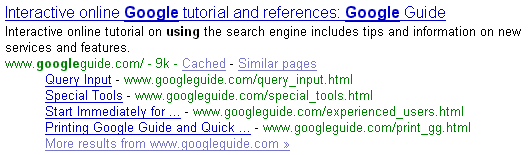
When I first made this site publicly available, Google Guide wasn’t in the first 100 sites on searches for [
Google guide ].
Thanks to the sites that linked to Google Guide and users who clicked
on Google Guide in their search results, Google Guide is in the top ten
results for many queries that relate to the content of the site. Being
listed so highly on Google has improved the traffic flow to Google
Guide.
Note: For the top ranked site, Google sometimes includes useful links from within that site.
Avoid devious tactics to improve your ranking.
If Google suspects that you are trying to deceive it web crawler and
thus its users by including hidden text, misleading or repeated words,
pages that don’t match your sites description, deceptive redirects,
duplicate site or pages, or other disingenuous tactics, then Google may
delist your site from its index.
And finally…
In addition to considering the number of links to your page and the
ranking of the linking page, to compute a page’s PageRank, Google
considers hundreds of factors including
- how fast a site is gaining links
- how long the links persist
- when your site acquired the links
- the click through rate (CTR) of Google’s search results, cached pages, favorites on the Google Toolbar
- the stickiness of your site (i.e., the effectiveness of your site in retaining individual users)
These factors and many others are described in the article “Great Site Ranking in Google The Secret’s Out” on
Buzzle.com.
Google periodically changes how it calculates a page’s importance,
thereby resulting in shifts in rankings, known as a Google Dance. Google
Guide’s placement in Google’s search results sometimes changes when
Google modifies or enhances their indexing algorithms.
I don’t try to keep up with the latest search engine optimization
tricks. Instead I strive to make searching Google easier by educating
users about Google services, capabilities, and features. When I am
successful, sites link to Google Guide pages and increase their ranks
and importance to Google.
Here are links to a few pages that discuss how to publicize your website and improve the ranking of your web pages.
In the next section,
Advertising Your Website, I’ll tell you how I increase traffic through running inexpensive ads.
tags (keywords): developing websites,
directory,
PageRank,
translation


 3:03 AM
 Trupasko